
- Hybrid, on-grid and off-grid designs
- Lithium battery storage
- Monitoring and maintenance
- Sized to your real load
 Solar
Power that fits how you live and work
A good solar system is sized from your load, not guessed. We list what you run, how long you run it and when you need it. Then we design the inverter, batteries and panels to match.
The result is a system that covers your needs without paying for capacity you will never use.
- Load assessment before any equipment is chosen
- Inverter, battery and panel sized as one balanced system
- Clean installation, testing and a walkthrough at handover
Everything in a complete solar system
Each part has a job. We choose and install them to work together.
Solar panel installation
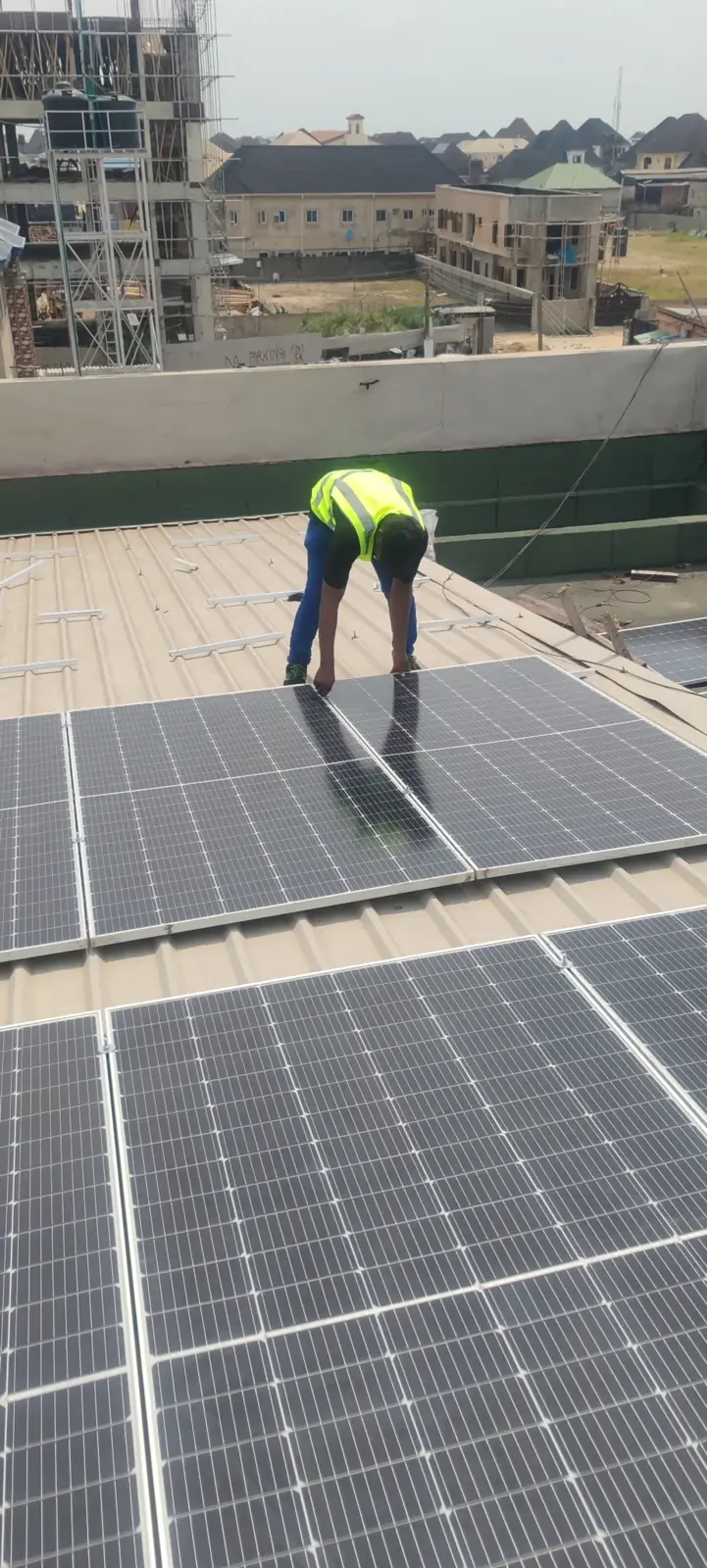
Mono-crystalline panels fixed on roof or ground structures, with the right tilt, spacing and string layout to cut shading and wiring losses.
Hybrid inverters
One unit that manages solar, battery, grid and generator. The kVA rating is chosen from your peak load and start-up surges.
Lithium (LiFePO4) batteries
Long cycle life, deep usable capacity and a built-in battery management system that protects the cells.
MPPT charge control
Maximum power point tracking pulls more energy from the panels, especially when light changes through the day.
Monitoring
See solar production, battery level and live load from your phone or a display, so problems show up early.
Maintenance and support
Panel cleaning, connection checks, battery health review and fault finding to keep output steady over the years.
Choose the right type of system
The three common designs, and the size ranges we usually see.
Types of solar system
Most homes and businesses in Nigeria choose hybrid, because it keeps working when the grid goes off.
| System type | How it works | Best for |
|---|---|---|
| On-grid | Solar feeds your loads and the grid together, with no battery. It shuts down when the grid is off. | Places with stable grid power that want to cut bills. |
| Hybrid | Solar, battery, grid and generator work together. The battery covers outages and nights. | Most homes, offices and shops. |
| Off-grid | Solar and batteries only, with an optional generator for backup. No grid needed. | Remote sites and places with no grid. |
Typical size ranges (guide only)
Your real size depends on your appliances. Use the free calculator below to get yours.
| Property | Inverter | Battery | Panels (550W) |
|---|---|---|---|
| Basic home (lights, fans, TV, fridge) | 1.5 to 3 kVA | 2.5 to 5 kWh | 3 to 4 |
| Medium home (adds freezer, pump, washing) | 5 kVA | 5 to 10 kWh | 6 to 8 |
| Large home or small office with AC | 7.5 to 10 kVA | 10 to 20 kWh | 10 to 16 |
Built for every kind of space
- Homes
- Offices and shops
- Schools and clinics
- Commercial buildings
From first visit to handover
- 1
Site visit and load check
We list your appliances and measure your roof or ground space.
- 2
System design
We size the inverter, batteries and panels to your load.
- 3
Equipment selection
We match proven equipment to your budget and needs.
- 4
Installation
Neat mounting, wiring and protection by our team.
- 5
Testing and handover
We test the system and show you how to use it.
Things people often ask
Can solar run my air conditioner?
Yes, if the inverter and batteries are sized for the AC start-up surge and how long you run it. The AC is usually the biggest load, so it must be included when the system is designed. Inverter-type ACs are easier on a solar system.
What is the difference between kVA and kWh?
kVA tells you how much power the inverter can deliver at one moment. kWh tells you how much energy a battery stores, or how much you use over time. You need both numbers to size a system.
How long do lithium batteries last?
Quality LiFePO4 batteries are rated for thousands of charge cycles. Real life depends on how deeply you discharge them, the temperature and how they are used.
What happens on cloudy days or in the rainy season?
Panels produce less, so the system draws more from the battery and then from the grid or generator if connected. We allow for this when designing a hybrid system.
Do panels need cleaning?
Yes. Dust and bird droppings reduce output, so we recommend regular cleaning and a yearly check of connections and mounting.
See your solar size and price in 2 minutes
Pick what you use. Get your size, a rough price, and a copy in your email.
Get My Size and PriceFree No sign-up
- 1
Pick appliances
Tap what you use
- 2
Get size and price
See it instantly
- 3
Get it by email
Keep your copy
The price is a rough guide. Our engineers confirm the final size and price after a site check.
Combine services into one coordinated project.
Power, electrical, security, ICT and automation, delivered by one accountable team.